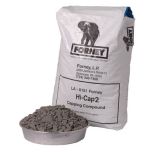
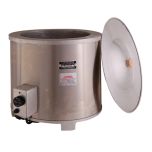
HI-CAP2 CAPPING COMPOUND, 40 BAGS PER PALLET
Product Code:
LAP-0151
Availability: In stock
Overview
BUY IN BULK - FULL PALLET QUANTITY
Product Code:
LAP-0151
Availability: In stock
BUY IN BULK - FULL PALLET QUANTITY
Hi-Cap2 Capping Compound is a premium sulfur-based capping material designed for preparing concrete cylinders and cores for compressive strength testing. In its liquid-viscous state, Hi-Cap2 fills surface imperfections and irregularities, creating a smooth, flat, and parallel bearing surface that helps ensure accurate and reliable test results.
Supplied in an easy-melt thin flake form, Hi-Cap2 offers faster melting, easier handling, and greater convenience than traditional ingots or briquettes. It is also a cost-effective alternative to neoprene pad systems while delivering consistent performance from batch to batch.
Hi-Cap2 is carefully plasticized to provide uniform load distribution during compression testing without deformation. After cooling for approximately two hours, the compound develops a minimum compressive strength of 8,000 psi, meeting the requirements of ASTM C617, Standard Practice for Capping Cylindrical Concrete Specimens.
As the material continues to cure, compressive strength increases further. A 2-inch (51 mm) cube typically achieves strengths between 8,000 and 9,000 psi (55–62 MPa), making it suitable for testing concrete specimens with strengths up to 16,000 psi (110 MPa).
The heat-purified and degassed formulation minimizes fumes and odors during melting, produces less dust during testing, and supports faster drying and turnaround times.
| Property | Value |
|---|---|
| Minimum Compressive Strength (2 Hours) | 8,000 psi |
| Typical Compressive Strength | 8,000–9,000 psi |
| Maximum Recommended Concrete Strength | 16,000 psi (110 MPa) |
| Melting Range | 230°F–240°F (110°C–116°C) |
| Optimum Pouring Temperature | 265°F–290°F (129°C–143°C) |
| Standard Compliance | ASTM C617 |
| Form | Easy-melt thin flakes |
Hi-Cap2 retains its full compressive strength and bond to concrete even when capped specimens are stored at 100% relative humidity prior to testing. Excess material can be remelted and reused repeatedly without degradation of its physical properties.
| Pack Size | Each |
|---|---|
| UOM | EA |
 WARNING: Cancer and reproductive harm